Money
Income, expenses, dues and receipts
Dues plans, collections, numbered receipts, cash and bank, and a double-entry ledger.
Service charges, lift maintenance, the caretaker’s wages and the heating bill in one ledger. Every neighbour sees their own balance and the building’s accounts, so the manager stops answering the same question every month.
The manager is usually a volunteer owner, and most of the work happens in the evenings, on the stairs.
The service-charge list hangs in the lift; who’s paid, who’s late, tenant or owner — it’s updated by hand every month.
Each flat is charged on schedule and late payers get a reminder. Neighbours see their own balance and pay by card, with a numbered receipt.
Income, expenses, dues and receiptsHeating, cleaning, lift maintenance: shared bills pile up in a folder and at year end someone asks where the money went.
Every expense goes into the ledger with its invoice; recurring costs arrive on their own each month. Neighbours open the income and expense report themselves.
ReportsThe owners’ meeting takes decisions, but the minutes book is at the manager’s home and new residents have no idea what was agreed.
Meetings, attendance and decisions are recorded with numbers. Every neighbour can read past decisions in the app.
Boards and decisionsThe lift breaks down and it’s mentioned in the group chat; nobody knows whether the engineer was called.
The fault becomes a task with an owner, a date and a status. When the engineer has been, it’s closed and the invoice is linked to the expense.
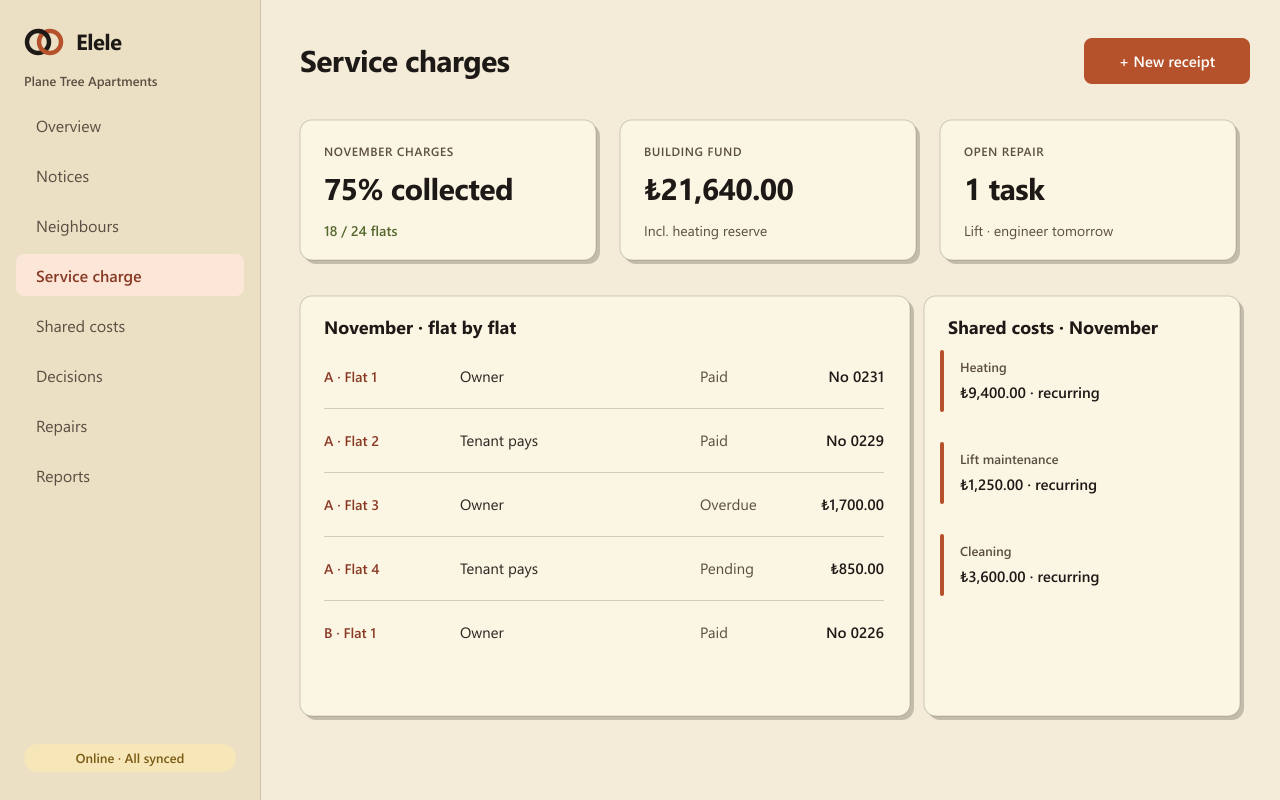
Tasks and projectsAn illustrative flow; the screenshot shows demo data.
The income and expense report shows last year’s actual costs line by line: heating, maintenance, cleaning, staff.
Next year’s cost estimate goes on the owners’ meeting agenda; the decision is numbered in the resolution book.
A service-charge plan is created from the agreed amount, with different amounts per flat if needed. Charges are raised every month.
Receipts are issued as neighbours pay and late payers are reminded. At year end, the plan and actuals are reported side by side.
The app calls residents “neighbours”, and the concepts managers know are right where you expect them.
They are ready at set-up; switch off what you don’t need and turn on more later.
Dues plans, collections, numbered receipts, cash and bank, and a double-entry ledger.
General assemblies, attendance lists, polls and a numbered resolution book.
Direct messages, a notification centre, preferences and dues reminders.
Every job has an owner, a due date and a status; projects move step by step.
Income and expenses, balances, receivables and activity reports, ready for the AGM.
Applications, approvals, roles and the member register; you decide who sees what.
Yes. Both are on the list as neighbours; the flat record says who pays the service charge, and the receipt is issued to whoever pays.
Yes. Flats are recorded with block and floor; charges, notices and reports can be filtered by block.
They see the income and expense report and the decisions. Personal details and other flats’ balances are visible only to the manager and auditor.
Set up your management, add the flats and raise the first service charge this month.